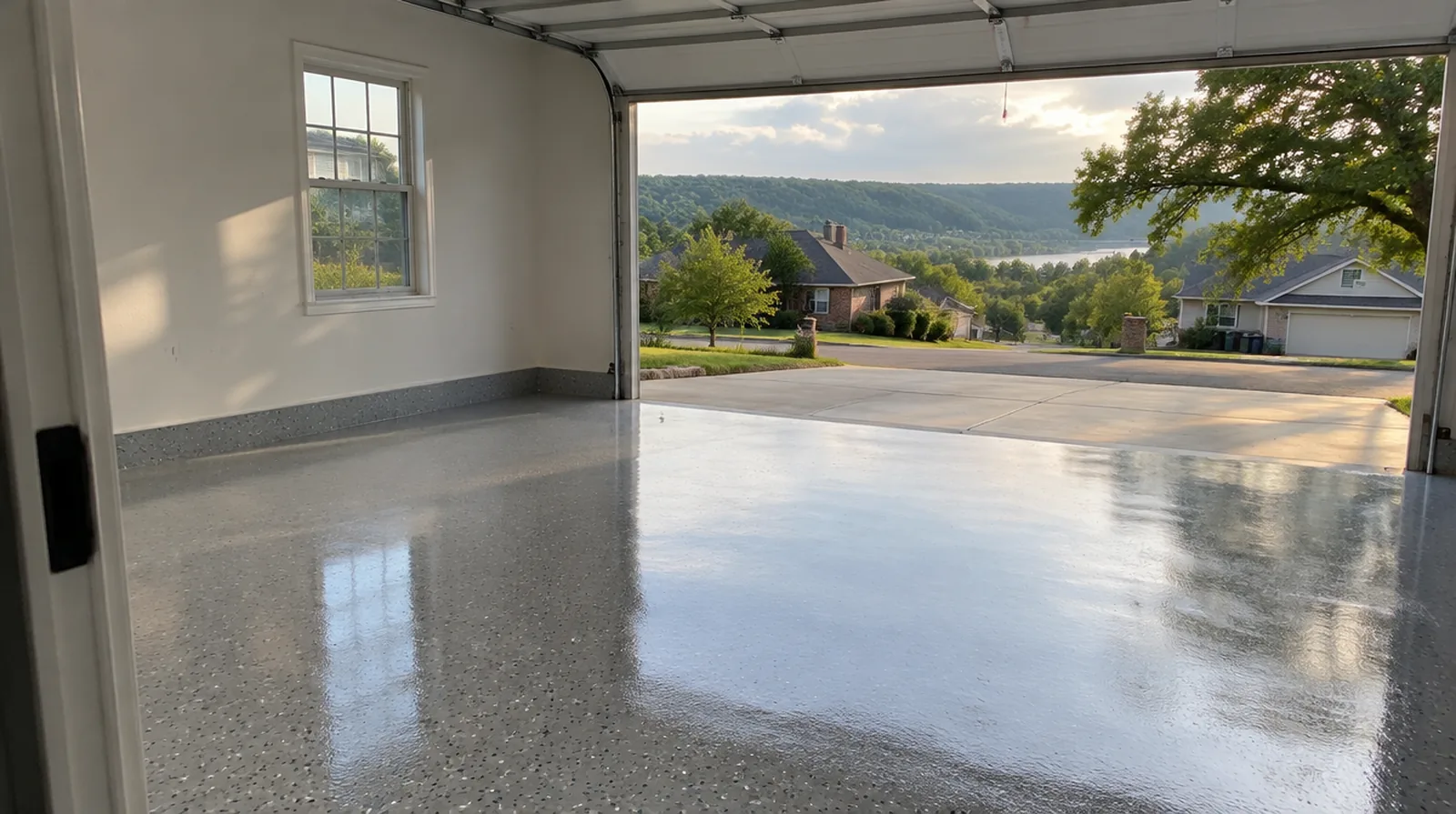
A river town is hard on concrete
Van Buren sits on the north bank of the Arkansas River, and the low ground near the river holds a lot of moisture. Slabs on that kind of soil can sweat in summer and push vapor up from below. That is the number one reason cheap coatings blister here.
So every estimate we do starts with a moisture check. If the slab is damp, we plan a vapor-blocking primer before we talk about colors.
Old buildings, new subdivisions
The historic district around Main Street and the Frisco depot has commercial buildings with concrete that has been patched, painted and glued over for decades. The subdivisions north toward Kibler and Cedarville have newer, flatter slabs. Both can get a great floor, but the prep is very different, and we price it honestly.
Services
Most of our work falls into a few groups:
Home garages
Ground and topcoated epoxy, often with a decorative flake layer, or a quick-cure polyaspartic system.
Business floors
Coatings for shops and storefronts, plus polished concrete for open retail spaces.
Fixes and protection
Repairing failed coatings, poured metallic finishes, and sealing driveways and patios.
Epoxy countertops for kitchens, rentals and bar tops.
Driveway coatings for worn, stained or spalled concrete drives.
Pool deck coating for older backyard pools that need a sealed, grippy surface.
Concrete patio coating for peeling porches, steps and back patios.
Common questions
Can you coat a floor in a historic building?
Usually yes. We grind off old paint and adhesive first. Some buildings have uneven slabs, so we may level low spots.
How long will I be out of my garage?
Two days is typical for epoxy. Polyaspartic can cut that to about one.
Do you handle the cleanup?
Yes. Dust is vacuumed as we grind, and we haul our trash.
Van Buren epoxy flooring, from Main Street to the county roads
Our work here splits between two very different kinds of buildings. Downtown, the brick storefronts along historic Main Street often sit on old slabs that have been patched, painted and covered many times over. Out toward Kibler, Rena and the newer streets off Pointer Trail, we find attached garages, shops and pole barns on newer concrete that mostly needs protection from mud, river humidity and daily wear. Van Buren epoxy flooring for each starts with the same honest look at the slab before anyone talks about colors.
Wondering whether a pole barn floor is worth coating?
If the barn holds a tractor, mower or side-by-side and you are tired of sweeping dust, a coating makes a big difference. If it is mostly hay storage, a sealer may be all you need. We will tell you which.
Older Van Buren homes and the garage that used to be a carport
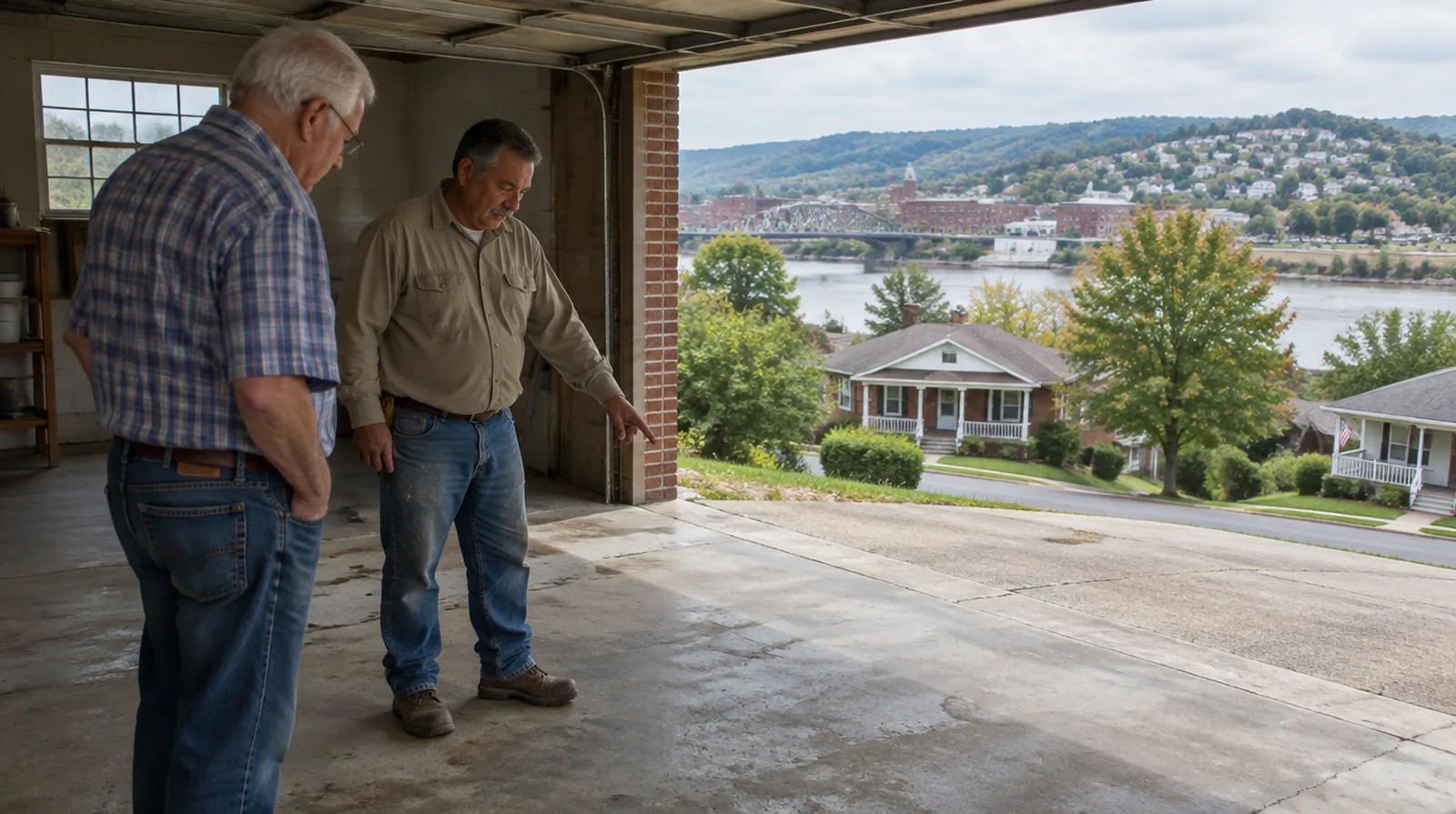
Drive through the neighborhoods off Main Street and Fayetteville Road and you will see plenty of brick homes from the 1950s and 1960s where the old open carport was walled in to make a garage. Those conversions are some of the most interesting floors we work on. The original carport slab was poured to sit outside, so it usually slopes hard toward the drive, has weathered edges and sometimes has a step or seam where a newer section was added. In the photo, one of our crew leads is standing with an older homeowner in a garage like that, looking at the slab and talking about what it needs.
The good news is that most of these slabs are thick, old concrete that has long since finished shrinking. Once we grind off decades of wear and fill the seam where the old and new pours meet, they take a coating very well.
River humidity and what it means for prep
Van Buren sits right on the Arkansas River, and the air here holds a lot of moisture from late spring through early fall. Morning fog off the river is common in the cooler months. That moisture matters for coatings. A slab that is cooler than the air can collect a thin film of water you cannot see, and primer laid over it will not bond well. We check the slab temperature and dew point before we open a single bucket, and if the numbers are close, we wait or bring in fans and a dehumidifier.
Older homes closer to the river and in low spots around town can also have more ground moisture coming up through the slab. A simple test tells us if a moisture-blocking primer is needed.
Where we work around Van Buren
Besides Van Buren itself, we take jobs in Alma, Kibler, Dyer, Mulberry and Cedarville, and in homes along the roads heading north toward the hills. If you live out on a country road, tell us when you call and we will plan the trip and equipment.
A typical Van Buren job, start to finish
- Walkthrough: we look at the slab, test moisture and talk about how you use the garage.
- Written quote: each step and coat listed so there are no surprises.
- Prep day: grinding, crack and seam repair, and cleanup.
- Coating: primer, base, chips or color, and a clear top.
- Handoff: cure times and care tips in writing.
More questions Van Buren homeowners ask
Can you coat the seam between an old carport and a newer addition?
Yes. We fill and grind it so the coating runs across it smoothly. A faint line may still show on solid colors, but chip floors hide it well.
Do you work on homes in the historic district?
We do. Garage and basement floors in older homes are a big part of our work.
What if my garage slopes a lot?
The coating follows the slope. We just make sure it does not pool at the low edge.
If you have a basement or shop as well as a garage, we can look at all of them in the same visit and give you one plan.
Many Van Buren garages also hold a chest freezer, a fishing boat for trips to Lee Creek or the river, and a workbench along the back wall. We plan around all of it, so tell us what stays in the garage and where you want it to go once the floor has cured.
Let us look at your floor
Call (479) 383-4562 to book a free visit in Van Buren.